
logotype
  • Home
  • About Us
  • Services
  • Projects
  • Life
  • Connect
Get in Touch
Logo F&W
  • Home
  • About Us
  • Services
  • Projects
  • Life
  • Connect
Get in Touch
  • Home
  • About Us
  • Services
  • Projects
  • Life
  • Connect
Blog

Category: Blog

Your blog category
Brand Identity vs Brand Image: What’s the Difference & Why It Matters for Your Business
Blog
May 28, 2026By F&W

Brand Identity vs Brand Image: What’s the Difference & Why It Matters for Your Business

What is Brand Identity?

Quick answer: Brand identity is what you say about yourself. Brand image is what people actually believe. Most businesses obsess over one and ignore the other – and it costs them.

Brand identity vs brand image – most Indian businesses confuse the two, invest in the wrong one, and wonder why customers don’t trust them. Here’s the difference and why it matters. Brand identity is everything your business intentionally puts out into the world – your logo, colours, typography, tone of voice, tagline, messaging, and visual style.
It’s the answer to: “Who do we want to be seen as?” Think of it as your brand’s intention. You control it completely. You design it, write it, brief it, and publish it. Examples of brand identity elements:
  • Logo and colour palette
  • Font choices and visual style
  • Brand voice (formal, casual, bold, warm)
  • Tagline and messaging framework
  • Website design and social media aesthetic
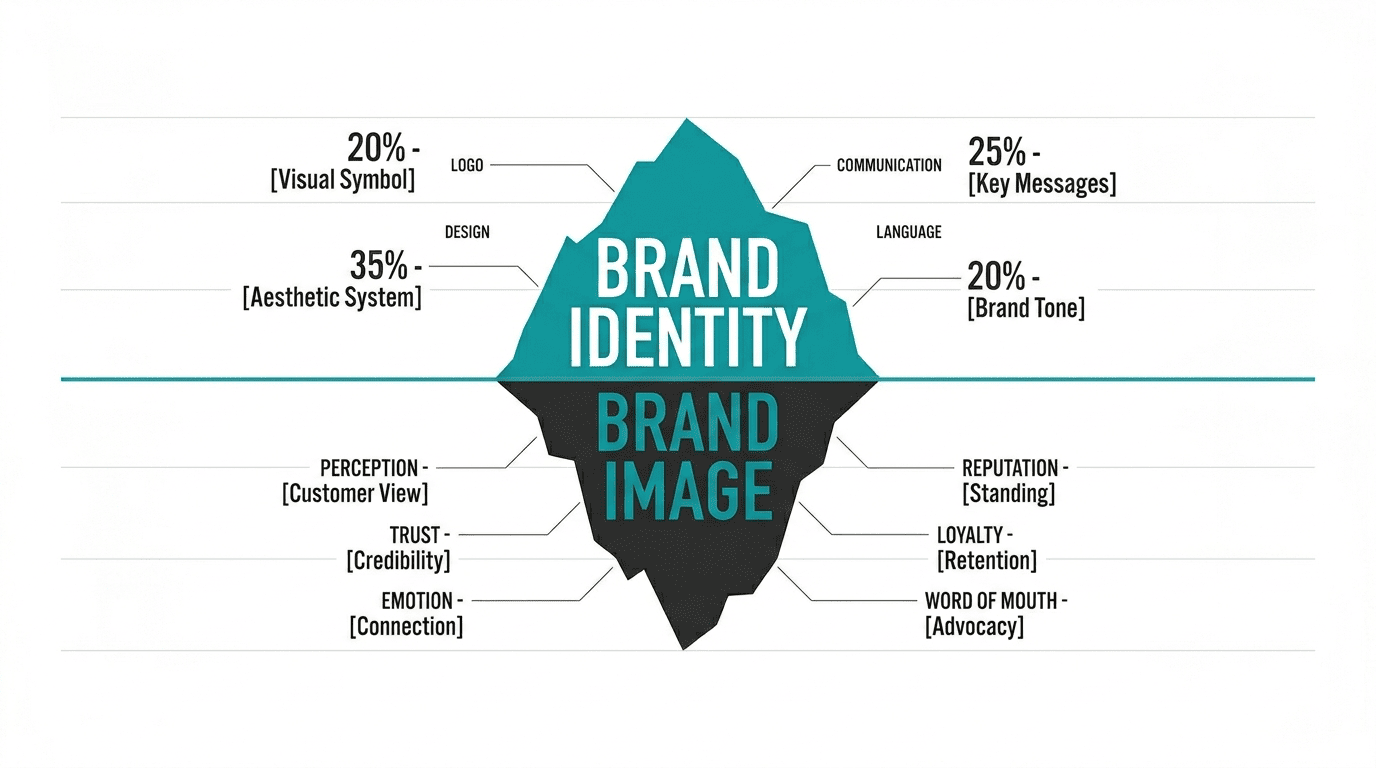
Brand identity vs brand image difference explained | Far & Wide Pune

The Simple Way to Remember the Difference


Brand Identity

Brand Image

Defined by

You

Your audience

Lives in

Your guidelines and assets

People’s minds

You can

Control it fully

Influence it gradually

Answers

Who do we want to be?

Who do they think we are?

Nature

Active

Passive


Why the Brand Identity vs Brand Image Gap Is a Business Problem

Here’s where most businesses go wrong: they invest in brand identity – a good logo, a clean website, professional content – and assume the image will follow automatically. It doesn’t work that way. Consistent branding across all channels can increase revenue by 23% – but only when the identity and the actual customer experience are aligned. When they’re not, you get a brand that looks polished but feels untrustworthy. Poor brand consistency costs mid-sized companies more than $6 million in lost revenue annually, according to a survey of senior professionals. That’s not a design problem. That’s a gap between identity and image problem.

This is the core brand identity vs brand image gap most businesses never notice until it’s too late.

A Real Example: The Pune Business Scenario

Imagine a premium real estate developer in Pune. Their identity is flawless – a sophisticated logo, a high-end website, aspirational tagline, beautifully shot brochures.
But their WhatsApp response time is 3 days. Their sales team gives different pricing to different leads. Their Google reviews mention “poor after-sales communication.”

Their identity says premium. Their image says unreliable.

That gap is what loses customers who were already 80% decided. And no amount of better design will fix it – because the problem isn’t the brand assets. It’s the brand experience

Why Brand Image Is Harder to Fix Than Brand Identity

Changing your logo takes a week. Changing what people think of you takes years.

It takes 5 to 7 impressions for consumers to even remember a brand – and many more consistent positive experiences to shift a negative perception.

81% of people say they need to trust a brand before purchasing. That trust isn’t built by a rebrand. It’s built by showing up the same way, every time, across every touchpoint – for long enough that the audience starts to believe it.

This is why brand image is the harder, slower, more important work.

How to Align Your Brand Identity and Brand Image

Step 1: Audit the gap Ask your actual customers how they’d describe your brand in 3 words. Then look at your brand guidelines. If the words don’t overlap, you have a gap.

Step 2: Fix the experience before the aesthetics If your brand identity says “reliable” but your delivery timelines are inconsistent – fix the delivery first. A rebrand won’t help. Behaviour changes image; design doesn’t.

Step 3: Make your brand guidelines usable 95% of organisations have brand guidelines, but only 30% use them regularly. If your team doesn’t know the guidelines exist, the identity breaks down at every human touchpoint.

Step 4: Use customer feedback as a brand mirror Reviews, DMs, comments, referral language – these tell you what image you’ve actually built. Read them like a brand audit, not just a customer service task.

Step 5: Be consistent, not perfect Brand visibility is 3.5x higher for consistently presented brands than inconsistent ones. Consistency compounds. A brand that shows up the same way every week for a year will outperform a brand that launches a “perfect” campaign once.

What This Means for Indian Businesses Specifically

In India’s market – especially in cities like Pune, Mumbai, and Bangalore – brand image is shaped heavily by community trust, word of mouth, and family recommendations.

A Marathi family choosing a builder in Pune asks their relatives first. A startup founder picking a marketing agency checks LinkedIn posts, reads Google reviews, and maybe calls someone they know who worked with them.

Your brand image exists in those conversations – long before a potential customer ever lands on your website.

That’s why the most important branding work isn’t always the most visible. It’s the quality of work you deliver, the responsiveness of your team, and the way you handle things when they don’t go perfectly.

The Bottom Line

Brand identity is the promise. Brand image is the reputation.

Understanding brand identity vs brand image is the first step to building a brand people actually trust. 

Every business needs both – and needs them to say the same thing. When they align, you get trust, loyalty, and the kind of word-of-mouth that no ad budget can buy.

When they don’t, you get a beautiful brand that nobody believes.

At Far & Wide, we work on both – helping brands build identities worth living up to, and communication strategies that make the image follow.
See our brand work →


Read More
Rectangle 1.jpg (1)
Blog
May 28, 2026By F&W

AI in Digital Marketing 2026: What’s Actually Changing for Indian Brands

Most Indian brands are using AI wrong
- and the gap is widening fast

India now has 958 million active internet users, growing 8% year-on-year. Rural India alone accounts for 57% of that base, expanding at nearly 4x the pace of urban India.
That scale means your audience is already AI-native – using voice search, chatbots, and AI-powered apps daily. The question isn’t whether AI matters to your marketing. It’s whether you’re keeping up with the customers who already live inside it.
Here’s what’s actually different in 2026.

AI in digital marketing India 2026

5 things that have genuinely changed this year

AI in digital marketing India 2026 has shifted faster than most Indian brands expected. Here’s what’s actually changed – and what you need to do about it. 

That scale means your audience is already AI-native – using voice search, chatbots, and AI-powered apps daily. The question isn’t whether AI matters to your marketing. It’s whether you’re keeping up with the customers who already live inside it.

Here’s what’s actually different in 2026.

1. Your next customer might ask an AI - not Google - to find you

But perhaps the most remarkable aspect of the evolution of 3D technology is its journey from spectacle to utility. What was once perceived as a gimmick or novelty has now become an integral part of numerous industries, from healthcare and architecture to manufacturing and education. Today, 3D technology is no longer confined to the realm of entertainment; it is a powerful tool with far-reaching implications. From medical imaging and surgical planning to architectural visualization and product design, its applications are as diverse as they are profound, reshaping the way we work, learn, and create.

2. WhatsApp automation is India's most underused marketing weapon

India runs on WhatsApp. AI-powered WhatsApp Business API deployments now handle customer queries, lead qualification, brochure sharing, and appointment booking – automatically, at midnight, without a team member online.
For real estate, hospitality, and retail brands – where WhatsApp is already the default – this is the biggest operational shift of 2026. One automated flow can do what a 3-person sales support team was doing two years ago.

3. AI video has crossed the quality line

Six months ago, AI-generated video looked synthetic. That’s no longer true.
Tools like Sora, Veo 3, Kling, and Runway now produce campaign-quality footage that would have required a full production crew in 2023. A bootstrapped brand in Pune can produce a brand film that competes visually with companies 10x its size.
The brands winning aren’t using AI to replace their creative team. They’re using it to produce more – faster iterations, more formats, more platforms – at the same cost.

4. Personalisation is no longer an enterprise-only feature

Personalisation used to mean your first name in an email subject line.
In 2026, it means an AI system serving two different users completely different content on the same website – based on browsing history, location, and purchase behaviour – in real time. AI-driven personalisation is already projected to drive over 40% of all digital sales globally (Statista).
For Indian e-commerce, fashion, food, and D2C brands – this is becoming the baseline expectation, not a premium feature.

5. Regional language marketing is now non-negotiable

90% of new internet users in India prefer content in their native language.
Hindi, Tamil, Telugu, Gujarati, Marathi – these aren’t secondary channels. They’re where your next 200 million customers actually live online.
AI has made multilingual content creation dramatically more accessible. But translation alone doesn’t convert. A Marathi-language campaign that reads like a translated English brief will underperform a genuinely local-feeling piece every time. Cultural adaptation is the work AI can’t do for you.

The stat that should matter to every small brand in Maharashtra

64% of Indian SMBs say AI has levelled the playing field – letting small teams produce professional content, run sophisticated ad campaigns, and compete against brands 10x their size. (Cloud 9 Digital, survey of 500+ Indian companies)
For brands in Pune, Nashik, Nagpur, and Aurangabad: this is the first time in digital marketing history that team size is not the main determinant of output quality.
A 5-person team with the right AI workflow can now produce, distribute, and analyse content at the level a 25-person team was doing in 2022.
The question has shifted. It’s no longer “can we afford to use AI?”

It’s “can we afford not to?”

What AI still cannot do - and won't any time soon

This is the section most AI-hype articles skip. Here’s the honest part.
AI cannot give your brand a point of view. It can generate a hundred ad copy variations. It cannot tell you what your brand genuinely stands for or why your Pune audience behaves differently from one in Delhi.
AI cannot build trust. Trust is built through consistent experience, honest communication, and accountability over time. AI helps you communicate faster. It doesn’t make you trustworthy.
AI cannot understand local nuance. A globally-trained model doesn’t know that a real estate brand in Ravet communicates differently than one in Koregaon Park. That local intelligence belongs to humans – and it’s your biggest competitive advantage.
AI cannot replace creative courage. The campaigns that actually get shared and remembered come from bold creative decisions made by people. AI scales the execution. The courage to be different is still yours.

A simple framework to start - without the tool rabbit hole

If you’re integrating AI into your marketing for the first time, don’t buy six platforms. Start here:
Pick one repetitive, high-volume task first. Email subject line testing, ad copy variations, or first-draft blog writing. Master one workflow before adding another.

Keep a human on anything customer-facing. AI generates. Humans approve. The voice going out to your audience must pass through someone who understands your brand.

Fix your data before your tools. AI is only as good as the data it runs on. Clean CRM data, properly tagged campaigns, and consistent analytics will give you more ROI from basic AI tools than any shiny new platform.

Build regional languages in from day one. If a meaningful portion of your customers speak Marathi, Hindi, or Tamil – that’s not a future consideration. Build it into your content strategy now

What we're seeing on the ground in Pune

After working with 250+ brands across Pune and Maharashtra – real estate developers, hospitality brands, manufacturers, D2C startups – here’s what the data and client work is actually showing us:
The brands pulling ahead aren’t using more AI tools. They’re using fewer tools with a sharper brief and a stronger brand foundation underneath.
AI works best when it has something real to amplify. A brand with a genuine story, consistent visual identity, and a defined audience will get dramatically more from AI than one still figuring out its positioning.
The sequence that works: Strategy first → Identity second → AI execution third.
Skip the first two and AI just helps you produce generic content faster. Faster generic content is still generic content.

What we're seeing on the ground in Pune

After working with 250+ brands across Pune and Maharashtra – real estate developers, hospitality brands, manufacturers, D2C startups – here’s what the data and client work is actually showing us:
The brands pulling ahead aren’t using more AI tools. They’re using fewer tools with a sharper brief and a stronger brand foundation underneath.
AI works best when it has something real to amplify. A brand with a genuine story, consistent visual identity, and a defined audience will get dramatically more from AI than one still figuring out its positioning.
The sequence that works: Strategy first → Identity second → AI execution third.
Skip the first two and AI just helps you produce generic content faster. Faster generic content is still generic content.

The bottom line

AI in digital marketing in 2026 is infrastructure – the way mobile payments and social media became infrastructure before it. Brands building AI into their workflows now will compound that advantage for the next three years.
But the real opportunity isn’t in the tools. It’s in using AI with genuine strategy, local market knowledge, and a brand point of view that no algorithm has been trained on yet.
That’s the edge Indian brands – especially in Maharashtra’s growing markets – actually have. Not because the tools are different here. Because the understanding of the audience is.

Read More

Let`s Connect

Let`s Connect
InstagramLinkedinYoutube

Far & Wide

Connect

Address : Far & Wide, 1st Floor, Shop no: 19/20, Harmony, Opp. Ravet Police Chowki, Ravet, Pune – 411033

Email: connect@farandwide.in

Phone: +91 7498757193

Working hours

Mon – Fri: 9.00am – 6.00pm

Sat : 9.00am – 1.00pm

Copyright © 2025 F&W. All Rights Reserved